


Jan Jerzy Milewski (August 1, 1950 – February 19, 2025)
SIMPLY “MR DOCTOR.”
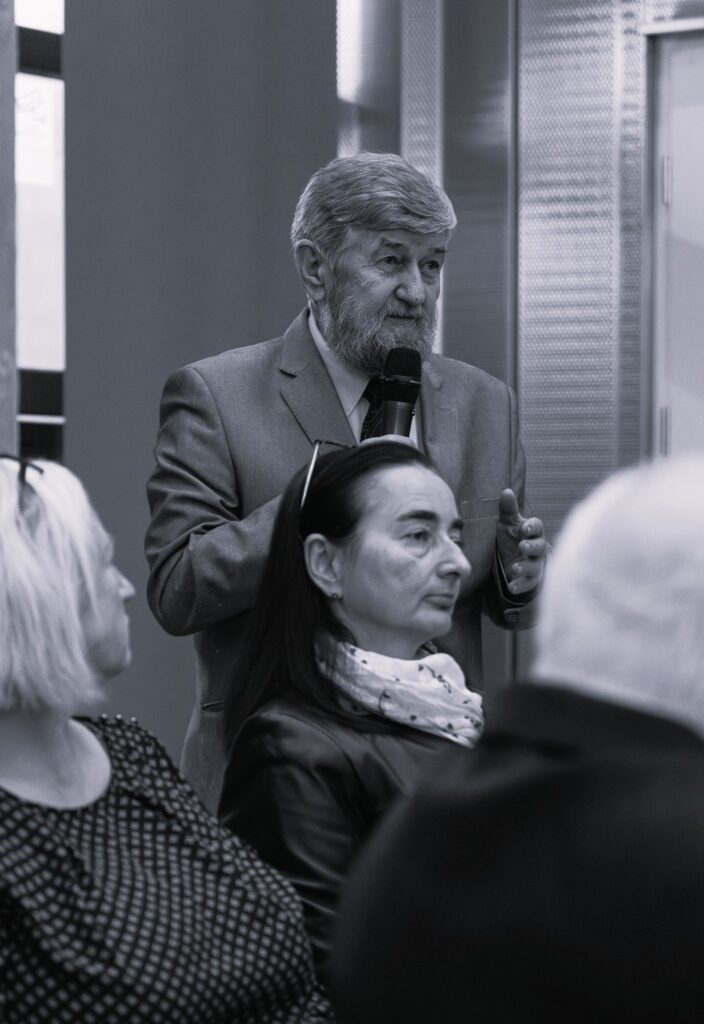
The creator and long-time editor of the „Borderlands History Bulletin”, Jan Jerzy Milewski, was one of the most renowned historians in Białystok. Kind, understanding, and warm – these are the qualities for which his students and colleagues will remember him. It is a profound loss that he is no longer with us.
Dr. Milewski’s passion was history. He completed his studies in 1974 and was employed at the Białystok Branch of the University of Warsaw, which in 1997 became the University of Białystok. In 1983, he defended his doctoral dissertation under the supervision of Professor Andrzej Garlicki. In 2000, he began working at the Białystok branch of the Institute of National Remembrance (IPN).
It is difficult to enumerate all the activities to which he devoted his life. Above all, he was a respected scholar and a highly regarded lecturer. Initially a member of the University of Warsaw Branch, and later of the University of Białystok, he held numerous positions: Dean of the Faculty of Humanities (1982–1985, 1996–1999), Deputy Director of the Institute of History (1992–1994, 1999–2000), and Head of Postgraduate Studies at the Institute of History (1985–1991). From 1983 to 1987, he served as President of the Białystok Branch of the Academic Sports Association. During his years at IPN, he was first Head of the Research Department and later Head of the Branch Office of Public Education.
From the beginning of his academic career, he was closely associated with the Polish Historical Society (PTH) and remained actively involved throughout his life. He served three times as President of the Białystok Branch of the Society. For many years, he was a member of the Branch Presidium, Secretary of the Branch Board, and Secretary of the Regional Committee of the History Olympiad (organized by the PTH). It was Dr. Milewski who organized conferences and book launches, hosted meetings with invited guests, and initiated the Historical Commemorations known as Zaduszki Historyczne [Historical Memorial Evenings] .
He was the driving force behind „Borderlands History Bulletin” – a journal focused on the history of the Polish-Belarusian-Lithuanian borderlands, while also presenting academic life in Poland, Belarus, and Lithuania. For this project, he invited an esteemed group of researchers from beyond Poland’s eastern border, including Algis Kasperavičius, Arvydas Nikžentaitis, Rimantas Miknys, Aleksander Krawcewicz, and Aleksander Smalianczuk. As editor of the „Bulletin” (he disliked being called editor-in-chief), he prepared 18 issues. While he welcomed contributions from all, he personally carried out much of the editorial work himself.
His research primarily focused on the history of northeastern Poland in the interwar period and during World War II. He wrote about the communities of Białystok, Suwałki, Lipsk, and Grodno – the last of which he visited frequently, both to attend conferences and to conduct archival research. He was also interested in Polish-Jewish relations during the war and, as one of the first scholars, conducted systematic studies on the Augustów roundup (a term he coined), significantly contributing to the broader dissemination of knowledge about this atrocity.
He often repeated: “One must seek what unites us” – and he consistently lived by this principle. He was deeply engaged in dialogue with historians from Belarus and Lithuania; in the mid-1990s, he served on the Polish-Belarusian Commission on History Textbooks, and he initiated collaboration with the Russian MemorialAssociation. He connected with people regardless of their background, education, or religion, earning widespread affection and respect.
He could often be seen carrying a bag full of books, papers, and newspapers. He was everywhere: in the archives, in reading rooms, at the university, at rallies and meetings… He read extensively and wrote tirelessly, producing over 300 publications. One of his most important works was the synthesis entitled The Białystok Voivodeship: An Outline of History 1919–1975 (Białystok, 2011). He participated in numerous scholarly conferences, eagerly contributed to discussions, spoke on radio and television, wrote for the local press, and visited schools. He had his own opinions and expressed them openly, yet he always remained understanding toward those with differing views. Despite his extensive academic output, he never pursued habilitation, always prioritizing urgent scholarly and social commitments over formal advancement.
He was a constructive critic. He kept a keen eye on events both in Białystok and beyond, and had a sharp sense of humor, often sharing witty, intelligent, and memorable remarks.
Dr. Milewski was attentive to others and remarkably generous with his time and support. His students and colleagues usually addressed him as Mr Doctor, and everyone knew exactly who they meant. Because while there may be many doctors, there was only one such figure.
Mr Doctor, we miss you dearly.